How to Find the Right Buyer for Your Tech Company

How to find the right buyer for your tech company
Selling a tech company is not simply a matter of finding someone willing to buy it. For many founders, the harder question is finding a buyer they trust to take the business forward.
The right buyer depends on what you want from the transaction and what you want to happen afterwards. Price matters, but so can the future of your management team, employees, customers, product and brand, and how the next owner intends to support long-term growth. You may want to remain involved, preserve the company's independence or find a long-term home for what you have built.
Defining those priorities early can make it much easier to identify the kind of buyer that fits your business.
How do you find the right buyer for your tech company?
Finding the right buyer starts with defining what a successful acquisition looks like to you. Then, you can identify acquirers whose ownership model aligns with those priorities and evaluate potential buyers on more than valuation alone.
Consider:
- how long the buyer intends to own the business;
- how much operational independence the company will retain;
- what happens to leadership and employees;
- whether the brand and product will remain intact;
- how the buyer intends to invest in and grow the business; and
- whether the buyer's long-term plans match your own.
The question is not simply “Who will buy my company?” but “Who should own my company next?”
1. Define what the right buyer means to you
There is no single definition of a good buyer. A founder who wants to remain involved may evaluate an opportunity very differently from someone preparing to step away. Similarly, someone who has spent decades building a specialist product and team may prioritize continuity over integration into a larger organization.
Think about the outcomes that matter to you beyond the transaction itself.
Your employees
Ask what typically happens to employees and management after an acquisition. Will the existing team continue to operate the business? Are functions likely to be consolidated? Looking at previous acquisitions can give you a better indication of how a buyer actually operates.
Your product and customers
Understand what the buyer intends to do with the product. Will development continue? Will customers be supported by the same team? Will the business remain independent or eventually be integrated into a wider platform?
Your role
Decide what you want your own involvement to look like. If you plan to stay, understand how much autonomy you will retain. If you want to leave, establish what kind of transition the buyer expects.
These priorities become your framework for evaluating buyers.
2. Understand the different types of buyers for tech companies
Different acquirers can offer very different futures for a software business. Ownership horizon, operational involvement and plans for the company after closing can all vary depending on the buyer's model.
Permanent homes and long-term software acquirers
For founders looking for a long-term home, one option is an acquirer that buys businesses with the intention of holding them permanently rather than preparing them for resale.
Omegro, an operating portfolio of Volaris Group, part of Constellation Software Inc. (TSX: CSU), follows this model by providing a permanent home for Enterprise Asset Management software businesses. We acquire established vertical software businesses with the intention of owning and growing businesses for the long term, preserving the specialist knowledge, customer relationships, people and identity that made each business successful while providing access to additional expertise and capability.
Even with a long-term owner, operating models differ. Founders should understand how acquired companies are supported, where decisions are made and what level of autonomy they retain.
Strategic buyers
Strategic buyers typically see value in combining your technology, customers or market position with their existing business. This can provide greater scale, distribution or resources, but may also involve deeper integration of products, teams or brands.
An important question is therefore not simply why a strategic buyer wants your company, but what role your business will have after the acquisition.
Private equity buyers
Private equity firms generally acquire businesses as investments, either directly or through portfolio companies. Your company could become a platform for further growth or an add-on to an existing business.
Founders should understand the intended role of the company, the buyer's investment horizon and what a future exit could mean for the business.
Individual buyers and search funds
Individual operators and search funds may acquire a company with the intention of becoming directly involved in running it.
In these situations, the incoming owner's experience, financing, operating plans and long-term intentions become particularly important.
Ultimately, the buyer you choose helps determine what happens to your company after you sell it.
3. Know where to look for potential buyers
Finding the right buyer does not necessarily mean putting the company on the market and waiting for offers.
If you operate in a specialist software market, look at organizations already active in your sector. Which groups have acquired similar businesses? Which groups understand your market and already own relevant businesses? Which long-term acquirers specialize in companies like yours?
Omegro focuses specifically on software businesses serving Fleet Management, Facilities Management, Equipment Rental, Marine and Asset Management. In specialist markets like these, an acquirer that understands the customers, economics and product requirements of the sector may see the business differently from a generalist buyer.
Your search might include:
- strategic companies in adjacent markets;
- software groups with a history of acquisitions;
- permanent-capital vertical software acquirers;
- private equity firms with relevant portfolio companies;
- search funds and individual operators; and
- buyers identified through an M&A advisor
The objective isn't the longest possible buyer list. It's a credible shortlist of acquirers with a genuine reason to value your business.
4. Look beyond the purchase price
A strong financial offer matters, but two similar valuations can lead to very different outcomes after closing.
When comparing buyers, consider ownership horizon, operating autonomy, management and employees, brand, product investment and the buyer's approach to growth.
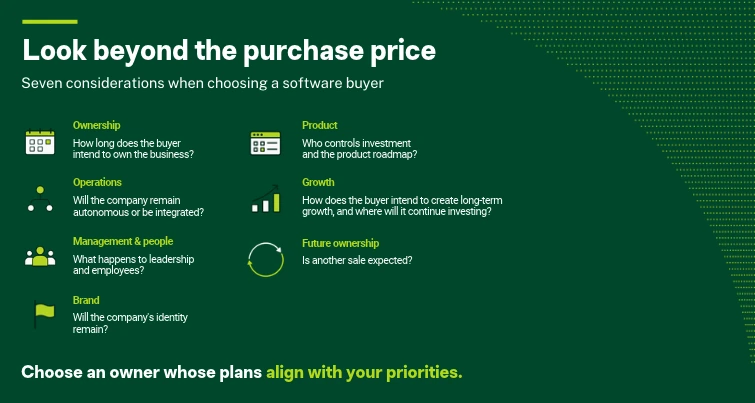
Growth strategies can look very different. Ask whether the buyer expects future value to come from developing management and people, continued product investment, deeper customer value and new market opportunities, operational improvement, or a combination of these.
Operational discipline matters in any well-run business. But founders should understand whether the buyer's plan is primarily about building the capabilities required for sustainable growth or delivering short-term cost reductions.
A buyer can meet your valuation expectations and still be the wrong fit for your priorities.
5. Ask potential buyers the questions that matter
Due diligence works both ways. Use conversations with potential buyers to understand how they behave as owners, not just what they are prepared to offer.
Ask:
- 1Why are you interested in our company?
- How long do you expect to own the business?
- What would you want to change after the acquisition?
- How much independence would the company retain?
- What happens to our leadership and employees?
- How do you plan to support our management team?
- Would our brand and product remain independent?
- How would product investment decisions be made?
- Where do you expect future growth to come from?
- What have you done with similar businesses you've acquired?
- What would success look like five or ten years after the acquisition?
Where possible, speak with founders who have previously sold to the buyer. What happened after closing can tell you more than an acquisition pitch about how that organization operates.
6. Look for alignment, not perfection

No buyer will necessarily meet every preference.
A strategic acquirer may offer greater distribution but require deeper integration. A private equity-backed buyer may bring capital and expertise but operate within a defined investment horizon. A permanent owner may provide a long-term home, although levels of autonomy, management support and access to wider capabilities can vary between acquirers.
The goal is to understand which trade-offs you are willing to make.
Creating a simple scorecard can help. Weight the factors that matter most to you, such as valuation, employee continuity, independence, ownership horizon and your own future involvement, before you begin comparing offers.
For many founders, selling represents the culmination of years or decades of work. It is worth considering not only what you receive when the transaction closes, but what happens to what you built afterwards.
Frequently asked questions
How do I find buyers for my tech company?
Potential buyers include strategic acquirers, private equity firms and their portfolio companies, permanent-capital software groups, search funds and individual operators. You can research relevant acquirers directly or work with an M&A advisor to develop and approach a broader buyer universe.
What do buyers look for when acquiring a software company?
Priorities vary, but software acquirers may consider recurring revenue, customer retention and concentration, profitability and growth, market position, product strength and management capability.
Should I choose the buyer offering the highest price?
Not necessarily. Consider deal structure, certainty of closing, ownership horizon and the buyer's plans for your employees, customers, product and brand alongside valuation.
How can I tell what a buyer will be like after the acquisition?
Look at comparable acquisitions and, where possible, speak directly with founders who have previously sold to the buyer. Their experience can help you understand whether the buyer's stated approach matches what happens after closing.
When should I start looking for a buyer?
You don't have to be ready to sell to understand the buyer landscape. Researching who acquires businesses like yours and how those organizations operate can help you make a better-informed decision when the time comes.
Finding the right long-term home for your business
There is no universally right buyer for a tech company. The right buyer is one whose ambitions for the business align with your priorities, whether that means continued independence, stability for your team, new resources or a long-term home.
Taking time to define those priorities, understand different ownership models and ask prospective buyers the right questions can help you evaluate an offer based on what comes next, not just what happens on closing day.
At Omegro, we provide a permanent home for Enterprise Asset Management software businesses across Fleet Management, Facilities Management, Equipment Rental, Marine and Asset Management. Our long-term ownership model is designed to preserve each business's specialist focus and independence while supporting continued development across management, people, products, customers and market opportunities.
For founders considering succession or the next stage of their company's journey, finding alignment with a future owner is a sensible place to start.
Considering the future ownership of your EAM software business? See Omegro's acquisition approach or start a confidential conversation with our Corporate Development team.