How Do You Choose the Right Buyer for Your Software Business

September 8, 2026
How do you choose the right buyer for your software business?
Selling a software business is one of the most important decisions a founder will make. While valuation often dominates discussions, the reality is that the right buyer can have a far greater impact on the future of your employees, customers, and legacy.
In this article, we explore what founders should look for in an acquirer and how to evaluate buyers beyond the purchase price.
Want to learn more? Listen to Episode 1 of The Omegro Effect: EAM Unlocked Podcast.
Selling your business isn't just about price
When founders begin exploring an acquisition, most conversations focus on valuation, deal structure, and closing terms.
Those factors matter.
But years after the transaction is complete, most founders don't reflect on the sale price. They think about what happened to the business afterward:
- Did the company continue to grow?
- Did employees have opportunities to develop?
- Did customers receive better support?
- Did the business become stronger, or slowly lose what made it successful?
The truth is that the buyer you choose can have a greater impact on your company's future than the deal itself.
For software founders, CEOs, and corporate leaders evaluating an exit, understanding what happens after acquisition is just as important as negotiating the purchase price.
Why the right buyer matters more than the highest offer
Not every buyer is looking for the same outcome. Some buyers are focused primarily on financial returns and future resale value. Others are committed to long-term ownership and operational growth.
Neither approach is inherently right or wrong. The key is understanding your own goals before entering a transaction.
If your priority is maximizing proceeds and exiting entirely, your buyer criteria may look very different than a founder who wants to protect employees, customers, products, and legacy.
Before evaluating buyers, sellers should ask themselves:
- What do I want my business to look like in five years?
- What happens to my employees after the transaction?
- What happens to my customers?
- Do I want the brand and culture to continue?
- Am I looking for an exit or a long-term successor?
Only after answering those questions can you determine whether a buyer is the right fit
What founders should look for in an acquirer
Many acquisition processes begin the same way: Buyers request financial information, review performance metrics, and conduct due diligence. The real differentiation comes later.
The strongest buyer should demonstrate a detailed understanding of:
Your market
- Do they understand the industry you operate in?
- Do they understand the trends shaping customer behavior?
- Can they speak intelligently about the future of your sector?
Your customers
- Do they know who buys your product?
- Do they understand customer challenges, buying cycles, and retention dynamics?
- Can they explain how they would help deepen customer relationships?
Your business model
- Do they understand your pricing structure?
- Do they understand your sales cycles?
- Do they understand your implementation requirements?
- Do they understand your operational complexity?
If a buyer struggles to answer these questions, it may indicate they're evaluating your business as a financial asset rather than understanding how it creates value.
Specialist acquirer vs generalist investor: What's the difference?
One of the biggest factors influencing post-acquisition success is whether the buyer possesses deep domain expertise.
A generalist investor may own businesses across dozens of industries, whereas a specialist acquirer focuses on a particular sector and develops expertise, networks, benchmarks, and operational playbooks within that market.
For Enterprise Asset Management (EAM) software businesses operating in specialized sectors like:
- Asset Management
- Equipment Rental
- Facilities
- Fleet
- Marine
Domain knowledge can significantly impact outcomes after the transaction.
What specialist buyers typically bring
- Industry-specific best practices
- Benchmarking against peers
- Market expertise
- Leadership development programs
- Experienced operating leaders
- Access to relevant networks
- Functional expertise in pricing, support, sales, and product management
The deeper the specialization, the greater the potential value beyond capital.
“Will somebody else be sitting in their chair after the acquisition?” - Andy Nelson, Portfolio Manager
Protecting your legacy after an acquisition
For many founders, legacy is the part of an acquisition that receives the least attention but carries the most emotional weight.
Years of effort have been invested building:
- A customer base
- A team
- A culture
- A reputation
- A product
So, the question then becomes: Who will carry it forward?
Legacy doesn't necessarily mean keeping everything the same; it means ensuring the business has a future.
The right buyer helps preserve what makes a company successful while creating opportunities for continued growth; and for many founders, that outcome is ultimately more rewarding than achieving the highest valuation.
%20(6).png)
What actually happens after a software company is acquired?
One of the most overlooked questions in M&A is: what happens after closing?
Most sellers spend months preparing for diligence but relatively little time evaluating the operating environment they will enter afterward.
The best acquisition outcomes occur when businesses gain access to:
Operational best practices
Experienced operators can help identify opportunities across:
- Sales & marketing effectiveness
- Pricing strategy
- Customer success
- Professional services
- Product development
- Financial management
Leadership development
Many founders build excellent businesses but have limited access to formal leadership development.
Operating groups that invest in managers, executives, and future leaders can significantly accelerate organizational growth.
Peer networks
Many CEOs describe leadership as a lonely role. One of the greatest advantages of joining an established software portfolio is learning from other leaders facing similar challenges.
Being surrounded by operators who have solved similar problems often becomes one of the most valuable benefits available post-acquisition.
How AI is changing the post-acquisition value equation
Artificial intelligence is rapidly redefining how software organizations operate.
Today's buyers are increasingly expected to provide more than capital and governance.
Sellers should evaluate:
- Does the buyer have an AI strategy?
- Are portfolio companies actively adopting AI?
- Are learnings shared across businesses?
- Is there governance around security, compliance, and data management?
- Can the buyer help accelerate AI innovation?
The organizations best positioned for the future are often those creating environments where knowledge and experimentation can scale across multiple businesses.
Questions every founder should ask before selling their business
Before selecting a buyer, consider asking:
Strategic questions
- What does success look like two years after acquisition?
- How do you help companies grow post-close?
- What is your ownership philosophy?
Industry questions
- What experience do you have in my market?
- Which similar businesses have you acquired?
- How do you support companies in this industry?
People questions
- How do you develop leaders?
- What opportunities exist for employees after acquisition?
- How do you preserve culture while driving improvement?
Technology questions
- How are your companies approaching AI?
- What operational best practices do you share across businesses?
- How do you help companies innovate?
The quality of these answers often reveals far more than the valuation multiple.
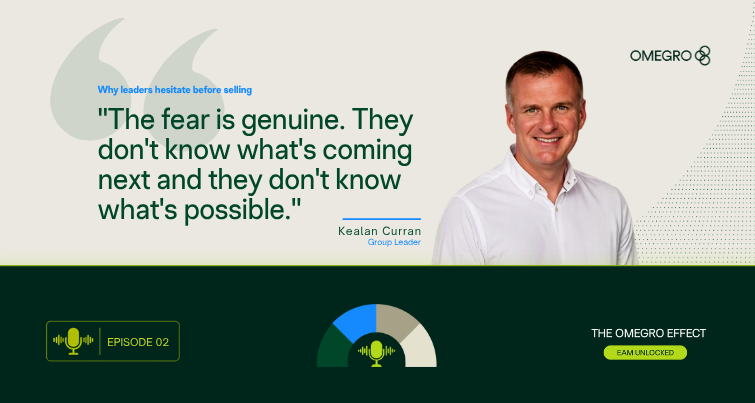
"I still have the autonomy to do what I want to do. The guardrails are on, but the autonomy remains." - Kealan Curran, Group Leader
The best acquisition outcomes start with alignment
The most successful acquisitions rarely happen because a buyer offered the highest price. They happen because both parties shared a vision for the business's future.
The buyer understood the market; the seller understood their own priorities.
And both sides were aligned on what success would look like years after the transaction closed.
Because when the paperwork is finished, the acquisition isn't over; it's just beginning.
For software founders, the most important question is often what comes next. To hear more perspectives on acquisitions, growth, leadership, and long-term value creation in EAM software, explore The Omegro Effect: EAM Unlocked Podcast.
About Omegro
Omegro provides a permanent home for Enterprise Asset Management (EAM) software businesses that support the world's most critical assets. Powered by our deep sector expertise, enhanced 5‑Stage Asset Lifecycle Framework and the Omegro Operating System, we accelerate the transformation of independent businesses into global category champions.
Contact us or visit omegro.com to learn more.